
Phantom Truths: A Ghost Hunting Story
The first thing the tour operator asked when the ghost tour commenced was whether anyone there believed in ghosts. Several enthusiastic and several shy hands were raised, but not a majority. I was, of course, among them. Still, believers seemed to be less than the tour operator was expecting. He proceeded to make a series of disclaimers about the topics he’d be speaking about, then led us off to our first stop.
That first stop was fine, and the second entertaining, but the third was the moment things started to get weird and I realized that we might actually be in for a bit more than we’d bargained for. Usually, I’ve found ghost tours to yield more bad information than useful information, and typically find they stop off at locations that are old but maybe not any more haunted than most other places. The third stop was an old house, with a legend about a peg leg ghost walking up and down stairs inside. As the tour guide began speaking, a walnut from a tree framing the road crashed into the sidewalk at unbelievable speed, landing on a manhole cover and the CLANG made everyone jump. As the guide continued, I watched the blinds on the upstairs window open as though someone was peeking out at an unexpected visitor. I turned to my friend with my eyebrows in my hair, mouthing “You seeing this shit?” and he gave me the universal silent nod that says “And it’s getting crazier”.
As I turned from him back to that upstairs window, I noticed a second peephole slit had opened in the blinds and as the guide finished his story, a third, much higher up, began to open.
This wasn’t nearly as upsetting, though, as what happened at the next stop.
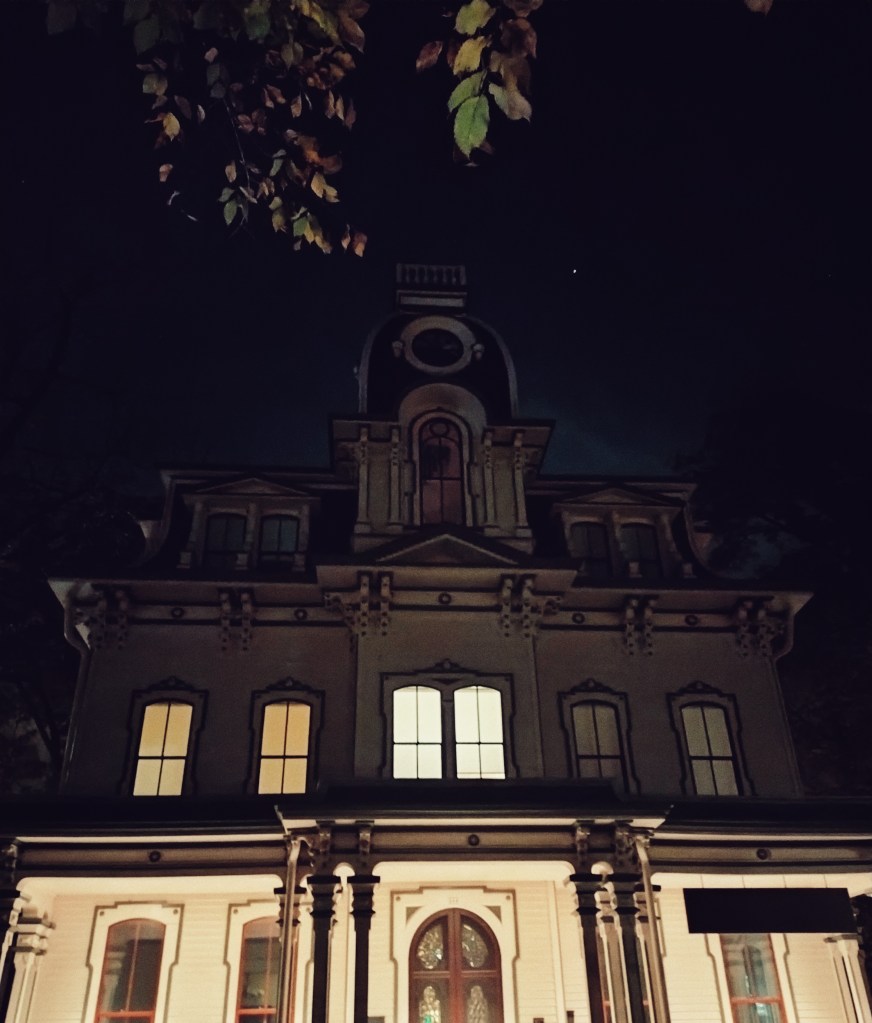
We crossed the street and walked down the block, past old houses now turned into government offices and law firms and bases for realty companies. We saw the house before we were close. It loomed. A giant old Victorian — properly Second Empire style, I’m told — with three stories, an observatory tower, and a widow’s walk, though we’re nowhere near a shore here. A life-sized dollhouse with a huge front porch. The kind of house you know was built to be a landmark by builders who wanted you to wonder what might be inside an exterior so extraordinary. We circled up to hear the story.
The Heck-Andrews house, we were told, was built immediately after the Civil War ended. Its original owners intended it to be a symbol of what reconstruction could bring, and in fact, they invested heavily in industries intended to bring people and their money down from the North. The Hecks lived and died there and nothing sadder than what normally happens to humans occurred, according to our guide’s story. And yet, as I stood in front of it, the house oozed immense sadness and seemed to both stretch and settle, to be full and empty, and the impression of vast, immeasurable cruelty and deliberate misunderstanding made me feel ill.
The guide was now beginning to speak about the third owners of the house, who purchased it in the 40s and my heart sank as he spoke about it.
Gladys Perry’s mother purchased the house in the 40s, and they lived there together and sometimes rented rooms. When Gladys’ mother died, she continued to occupy the house alone through the 80s. The guide referred to her as a “bag lady” who wandered around collecting trash. I bristled. And the bristle was not entirely my own. As he spoke those words, I received the emotion from outside myself and also reacted to it internally. This sensation is difficult to describe to those who don’t sense spirits the way that I do. It is similar to empathy — an awareness that the emotion of another is creating an emotion in you.
I was angry at the description and an overwhelming background of sadness continued to surface. Impressions jumped out — misunderstanding, deliberate misunderstanding, so what if I did, so what if I do, he’s not telling it right, he’s leaving things out, it was always this way.
The guide went on — the house fell into disrepair, it became an eyesore, the weird lady who occupied it was a danger to herself and to the community, the state wanted to seize it, the police were sent and when they arrived found mountains of trash piled to the ceiling and the wretched old woman rotting in a bedroom upstairs, covered in frostbite and bedsores and refusing to be excised from the place. How she was carried out and sent to the hospital to be cared for, and how, he said so casually and so certainly, she died immediately after. The state owned the house now and cleaned it up, but it remained unoccupied and was sold recently, and remains still unoccupied.
As he told this I felt my head cock sideways involuntarily in the way that you do when someone has told half a truth when you were present for the whole of it. This didn’t make sense, though I didn’t know the details as I stood on the sidewalk. I was just sure it wasn’t quite right. We were then told we could approach the house and look in the windows. Nobody, it was shared, was allowed in except for tours which happened about once a year around the Christmas holiday, so this was probably as close as we’d get to the splendid interior.
As I placed my foot on the porch step I projected with my inner voice, “I know you’re here and that you hate this, understand my intent is to know you and this place better, I enter here with respect for you and your place, not to ogle at your suffering but to place it in context”. It felt in my stomach like a rubber band being removed from something too wide for it. I approached the left side window and pressed my face into the glass. Inside there were columns and wide rooms, high ceilings. The first floor, at least seemed to have been repaired and repainted, but nothing seemed to have been changed since the house was built. No terrible new flooring or fixtures. The right side of the house had a stained glass window with what looked like stylized magnolia flowers depicted at the back.
It was heart-shatteringly empty. Sterile. Without joy. The rooms seemed to expand and contract, the staircase, which I had to crane my neck to see, stretched elastic to the upper floors. At the back of the room, there seemed to be some kind of poster for a realty company. Some lifeless Helvetica font, nonsense corporate slogan. Investment, enlivening, regenerating, stimulus.
I understood that the ghost of Gladys was tied to the house somehow at that moment. The life she had lived, inaccurately represented to me, was wrapped in its walls. Her life, as it turned different than her expectations became merged with it, and the final brutal separation was so jarring that its impression remained here. An entity certainly, projected and compacted out of human suffering and desire.
Gladys didn’t die immediately after being taken forcibly from her home by the state. As I researched later that night I learned she was relocated to an apartment and lived for several years after she and her home were separated from one another. But I also found more detail on her life before the house. How she had three serious boyfriends, whose adoring letters to her reference “oceans of love” and beg her not to bob her hair. How she worked at the DMV her whole career and retired in the 70s. How she wore white pancake makeup in the later stage of her life, which many seem to interpret as a desire to be seen as a ghost while still living and not to be seen. How the way she searched through the trash was deliberate, as though she were looking for particular things to bring home.
Further, I found a video of Gladys’ house being cleaned up, set to spooky music (in what I think to be extremely poor taste). The “piles of trash to the ceiling” aren’t nearly as high as was explained to me. And while I don’t deny that this appears to be the house of a hoarder, it doesn’t seem nearly as bad as what I’ve seen on TLC or even in my own grandmother’s place.
What strikes me about this story is the extreme level of exaggeration people feel they must do to distance themselves from relating to Gladys. I don’t claim to know what occurred in her life to cause her to meld emotionally with her house, but I do know that it must have been traumatic. Something occurred here that caused the trajectory of Gladys’ life to run a different path than what she or her family may have expected. Something happened that made her wish to stay there in that beautiful, crumbling mansion, surrounded by things she felt were special, despite their lack of value to those around her. Most people’s lives do not run their expected trajectory. Most people wish to return somewhere safe and to be surrounded by things they find valuable. Most people do wish that the perception of others if it can’t fall in line with their own perception of themselves, should be averted elsewhere. Most people have a support system better than Gladys’, whose only support seems to have been the stylized Corinthian columns of her house.
The other thing that strikes me about Gladys’ story is the telling of it in a manner where she is the frightening, haunting presence in it and not the spectre of the state that seized her property and banished her to finish her existence in a hollow apartment building while it proceeded to rifle through her belongings and sterilize her place to conform better with their vision of what a historic district should look like. Such a section of a city should be filled with houses in which nearly nobody lives. Such a district should be visited by the common people, but they should not stand on the sidewalk too long. If they can pay for the once-a-year tour, they should be allowed inside the house, but otherwise, they will need to press their faces to the glass and crane their necks and wonder. If they wish to engage with the stories told about these places they will need to accept half-truths and discard their empathy for the real people who lived them. They must affirm their sanity by affirming that Gladys’ house is best kept empty and they must concede that they agree that they and Gladys have no right to determine how they live.
One of the stops on our tour was the governor’s mansion where a funny little tale is told about a haunted bed. The lawn of the mansion is all lit up with Halloween decorations of animatronic ghouls and inflatable characters. As we approach, the guide points out that the mansion was built by prison laborers and that the brick sidewalk we are walking on contains bricks on which prisoners signed their names. He stops and points one out, and we all scatter away so as not to step on it. I notice another one closer to the road. The names are indecipherable but they are part of the brick forever. The impression of the person stamped irreversibly onto the building they were forced to become a part of. The inflatable pumpkin cackles in the background.
Further Reading on the Heck-Andrews house.
- The Heck-Andrews House Inside Out – Goodnight Raleigh
- The Ghost of Blount Street – Goodnight Raleigh
- Inside the Heck-Andrews House
 Dead Ringing
Leave a comment